
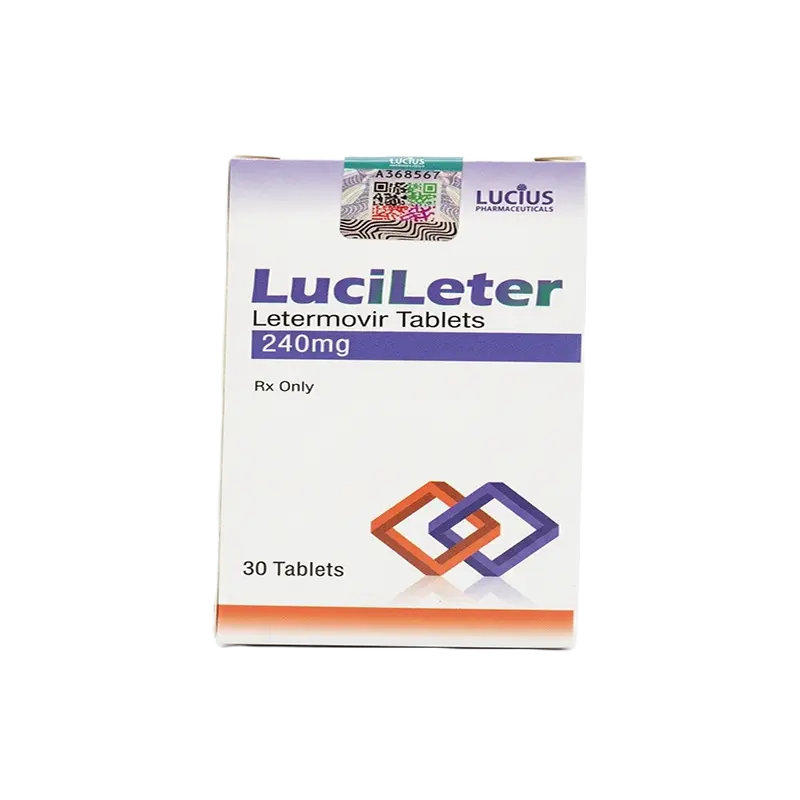
LuciLeter (Letermovir) 240 mg & 480 mg — CMV Prophylaxis for Transplant Patients
Inquire NowGeneric Name: Letermovir
Brand/Trade Name: LuciLeter
Available Strengths: 240 mg and 480 mg tablets
Manufacturer: Lucius Pharmaceuticals (Lao) Co. Ltd., Laos
Drug Class: Antiviral — CMV Terminase Complex Inhibitor
Available As: Oral tablets | IV Infusion (240 mg / 480 mg)
Prescription Required: Yes — For use only under specialist supervision
⚠️ Important Notice: LuciLeter (Letermovir) is a prescription-only antiviral medicine used in post-transplant care settings. It must be prescribed and monitored by a qualified infectious disease specialist or transplant physician. Do not start, stop, or adjust this medication on your own.
What Is LuciLeter (Letermovir)?
After a stem cell or organ transplant, the immune system goes through a period of deep vulnerability. The body’s natural defenses — which have been deliberately suppressed to prevent rejection — can no longer hold back viruses that a healthy immune system would normally keep dormant.
One of the most dangerous of these is Cytomegalovirus (CMV) — a herpes-family virus that nearly 50–80% of adults carry silently in their bodies. In healthy people, CMV never causes problems. But in transplant patients, CMV reactivation can escalate rapidly into life-threatening pneumonia, hepatitis, or organ damage.
LuciLeter provides the protective barrier these patients need.
Manufactured by Lucius Pharmaceuticals (Lao) Co. Ltd. in Laos, LuciLeter contains Letermovir — a first-in-class antiviral that works through a completely different mechanism from older antiviral drugs. It is one of the most significant advances in post-transplant infection prevention in recent years, and is now accessible to patients across Asia and developing markets through 100Meds.
If you are also managing other post-transplant complications or hematology-related conditions, you can explore our full Oncology product range or Aplastic Anemia treatment category — many transplant patients require support across both areas.
What Is LuciLeter Prescribed For?
Primary Indication: CMV Prophylaxis After Allogeneic Stem Cell Transplant (HSCT)
LuciLeter is indicated for the prevention of CMV infection and disease in adult patients who are CMV-seropositive and have received an allogeneic hematopoietic stem cell transplant (HSCT).
This is the indication for which Letermovir first received regulatory approval. On November 8, 2017, the U.S. FDA approved Letermovir (Prevymis) for exactly this purpose — making it the first new CMV medicine to receive FDA clearance in 15 years.
The landmark Phase 3 clinical trial told a compelling story: only 37.5% of patients on Letermovir developed clinically significant CMV infection by week 24 post-transplant, compared to 60.6% in the placebo group — a result that was statistically highly significant (P<0.0001). Beyond just reducing infection rates, Letermovir was also associated with lower all-cause mortality — 12% vs. 17% at 24 weeks.
Expanded Indication: CMV Prevention After Kidney Transplant
In June 2023, the FDA approved a new indication for Letermovir — prophylaxis of CMV disease in adult kidney transplant recipients at high risk, specifically patients where the donor is CMV-seropositive but the recipient is seronegative (D+/R−). This expansion reflects the growing evidence base for Letermovir across transplant settings.
Previous standard-of-care antivirals for CMV prophylaxis — primarily ganciclovir and valganciclovir — work but come with a significant drawback: myelosuppression. They suppress bone marrow activity, reducing blood cell counts at the exact moment when a post-transplant patient’s bone marrow needs to recover. This created a painful clinical dilemma — protect against CMV but risk blood cell suppression.
Letermovir resolves this dilemma. In clinical trials, bone marrow suppression rates were statistically similar between the Letermovir and placebo arms — meaning Letermovir provides robust CMV protection without the bone marrow cost. For patients recovering from HSCT, this distinction matters enormously.
How Does LuciLeter Work? (Mechanism of Action)
To understand why Letermovir is considered a breakthrough, it helps to understand what it targets.
CMV reproduces inside the cell through a tightly choreographed process. Near the end of that process, a molecular machine called the viral terminase complex takes newly replicated strands of viral DNA and packages them into capsids — essentially filling and sealing the viral envelopes that will go on to infect new cells.
Letermovir directly blocks this terminase complex. By inhibiting the enzyme responsible for packaging viral DNA into capsids, Letermovir prevents CMV from successfully completing its replication cycle. No complete capsids means no infectious viral particles. No infectious viral particles means no active CMV infection.
This is a first-in-class mechanism — no other approved antiviral works this way. Unlike older antivirals that interfere with viral DNA synthesis (and by extension, can affect human cells too — causing toxicity), Letermovir targets a viral structure with no human counterpart. This is the molecular reason behind its superior tolerability profile.
Dosage — How to Take LuciLeter
Standard Oral Dosing:
Without cyclosporine:
480 mg once daily (typically one 480 mg tablet, or two 240 mg tablets)
With cyclosporine (important dose reduction):
240 mg once daily — because cyclosporine significantly increases Letermovir blood levels. Using the full 480 mg dose alongside cyclosporine would result in overexposure.
When to Start and How Long to Continue:
- Begin between Day 0 and Day 28 post-transplantation (before or after engraftment)
- Continue through Day 100 post-transplantation
- For kidney transplant recipients: treatment typically continues through approximately Week 28 (~200 days) post-transplant
How to Take It:
- Take at the same time each day
- Can be taken with or without food
- Swallow tablets whole — do not crush, break, or chew
- If using IV formulation: administered as a 1-hour intravenous infusion — this route is reserved for patients who cannot take oral medication
Dose adjustments may be needed based on renal function and co-administered medications. Your transplant physician will determine the exact dosing schedule for your situation.
Key Clinical Benefits of LuciLeter for Patients and Caregivers
Proven reduction in CMV infection rates: The Phase 3 trial data behind Letermovir’s approval showed a reduction in clinically significant CMV infection from 60.6% down to 37.5% at 24 weeks post-transplant — a meaningful, statistically robust reduction.
No bone marrow suppression: This is the benefit that sets Letermovir apart from older CMV antivirals. Transplant patients are already recovering fragile bone marrow function — they cannot afford an antiviral that adds to that burden. Letermovir doesn’t.
Associated with better survival outcomes: Beyond infection prevention, Letermovir was associated with improved 24-week and 48-week all-cause mortality compared to placebo in the pivotal trial — a benefit that reflects what happens when a serious opportunistic infection is successfully prevented.
Oral convenience: LuciLeter tablets can be taken at home. For transplant patients who are already managing complex care routines, not needing an extra IV infusion for prophylaxis is a genuine quality-of-life benefit.
Accessible generic alternative: LuciLeter, manufactured by Lucius Pharmaceuticals in Laos, makes Letermovir therapy financially accessible to patients in Southeast Asia, South Asia, and markets where the branded version (Prevymis) may be cost-prohibitive.
Side Effects — What Patients Should Know
One of Letermovir’s clinical advantages is a relatively clean side effect profile compared to alternative CMV antivirals. However, no medicine is entirely free of adverse effects.
Commonly Reported Side Effects:
- Nausea or vomiting
- Diarrhea
- Fatigue or tiredness
- Peripheral edema (swelling in hands or feet)
- Abdominal discomfort
- Cough
- Headache
These are generally mild to moderate in severity and often resolve as the body adjusts.
Less Common but Clinically Notable Side Effects:
- Atrial fibrillation or flutter (irregular heart rhythm) — has been reported in some patients; heart rhythm monitoring may be appropriate
- Elevated liver enzymes — liver function should be monitored periodically during therapy
- QTc prolongation — some degree of QTc interval change has been noted; discuss this with your physician if you have a history of cardiac arrhythmia
What LuciLeter Does NOT Typically Cause:
Unlike valganciclovir and ganciclovir, Letermovir is not associated with significant myelosuppression — meaning it does not typically reduce white blood cell, red blood cell, or platelet counts. This is one of the primary reasons it is preferred in the post-transplant setting.
If you notice any irregular heartbeat, unusual swelling, jaundice (yellowing of skin or eyes), or any symptoms that concern you, contact your transplant team promptly.
Important Warnings and Precautions
Tell your doctor before starting LuciLeter if you:
- Have known heart rhythm problems or are taking medications that affect heart rhythm
- Have liver disease (dose adjustments may be needed)
- Have severe kidney disease or are on dialysis
- Are pregnant, planning pregnancy, or breastfeeding
- Are taking any other medications — prescription, over-the-counter, or herbal
Pregnancy and Contraception:
Based on animal study data, Letermovir may potentially cause harm to a developing baby. Women of childbearing potential should use effective contraception during treatment. If pregnancy is discovered during treatment, notify your physician immediately.
Breastfeeding:
It is not known whether Letermovir is excreted in human breast milk. Given the potential risks, breastfeeding is generally not recommended during treatment. Discuss this with your physician.
Pediatric Use:
Letermovir has not been fully established as safe and effective in patients under 18 years of age. Pediatric dosing guidelines exist in some settings — consult a specialist with specific expertise in pediatric transplant medicine.
Drug Interactions — Critical Information for Transplant Patients
This section deserves careful attention. Transplant patients are almost always on complex multi-drug regimens, and Letermovir has several significant interactions.
Letermovir is a moderate inhibitor of CYP3A and a substrate of drug transporters — meaning it affects how other medications are processed in the body, sometimes raising their blood levels to potentially dangerous ranges.
Tacrolimus (Critical Interaction):
Tacrolimus is the most commonly used immunosuppressant after transplant. Letermovir significantly increases tacrolimus blood levels — in some cases by 3 to 5 times. Tacrolimus dose reductions and increased therapeutic drug monitoring are mandatory when starting or stopping Letermovir. Failure to manage this interaction can result in tacrolimus toxicity.
Cyclosporine (Dose-Adjustment Interaction):
As noted in dosing: cyclosporine raises Letermovir levels, requiring the Letermovir dose to be reduced to 240 mg/day. Conversely, Letermovir also increases cyclosporine exposure — requiring monitoring.
Other Interactions to Discuss With Your Doctor:
- Sirolimus / Everolimus — levels may increase significantly
- Statins (e.g. simvastatin, atorvastatin) — Letermovir may raise statin levels, increasing the risk of muscle toxicity (myopathy)
- Pimozide — contraindicated (do not use together)
- Ergot alkaloids — contraindicated (do not use together)
- Voriconazole — interaction may affect antifungal efficacy; discuss with your physician
- Midazolam and other benzodiazepines — levels may be affected
- Warfarin — INR monitoring required
Bring your complete medication list — including vitamins, herbal supplements, and over-the-counter drugs — to every transplant clinic visit. Medication changes during Letermovir therapy should always be discussed first.
For a comprehensive drug interaction reference, the U.S. National Library of Medicine’s MedlinePlus page on Letermovir provides a patient-facing drug reference maintained by medical experts.
Storage Instructions for LuciLeter Tablets
- Store at room temperature, below 25°C (77°F)
- Keep in a cool, dry place away from direct sunlight and moisture
- Keep in the original blister packaging until ready to use
- Store out of reach of children and pets
- Do not use tablets past the expiry date printed on the packaging
- Do not store in a bathroom — humidity can degrade tablets over time
About Lucius Pharmaceuticals (Lao) Co. Ltd.
Lucius Pharmaceuticals, based in Laos, is part of a growing wave of pharmaceutical manufacturers in Southeast Asia producing generic versions of complex medicines — including antivirals, oncology drugs, and transplant-support medications — for patients across the region and globally.
LuciLeter represents their commitment to making clinically advanced medicines accessible to patients who would otherwise face significant barriers to treatment — either geographic or financial. Generic manufacturing plays a critical role in global healthcare equity, and companies like Lucius Pharmaceuticals are an important part of that picture.
Related Medicines Available at 100Meds
Patients recovering from transplant procedures — or managing conditions that may require transplant — often need access to a range of specialist medicines. The following products on our platform may also be relevant to your care team:
- Aplastic Anemia treatments — Many patients who undergo HSCT do so for aplastic anemia or bone marrow failure conditions. Explore our full range of aplastic anemia medicines.
- Elopag 25 mg (Eltrombopag) — A thrombopoietin receptor agonist used in severe aplastic anemia and thrombocytopenia, often relevant in the transplant patient population.
- Leukemia treatments — HSCT is a key treatment modality for leukemia patients; our leukemia range supports patients across the treatment journey.
- Hepatitis medicines — CMV can cause hepatitis in immunocompromised patients; our hepatitis product range may be relevant for concurrent management.
- Browse our full Oncology range →
These products are listed for reference and informational purposes only. All treatment decisions must be made by a qualified transplant physician, hematologist, or infectious disease specialist based on the individual patient’s clinical situation.
Frequently Asked Questions About LuciLeter (Letermovir)
Q: What is LuciLeter used for?
LuciLeter contains Letermovir, an antiviral medicine used to prevent CMV (Cytomegalovirus) infection after allogeneic stem cell transplant (HSCT) and — more recently — in high-risk kidney transplant patients. It is not a treatment for active CMV disease; it is a prophylactic medicine used to stop CMV from reactivating in the first place.
Q: What is the generic name of LuciLeter?
The generic (INN) name is Letermovir. LuciLeter is the brand name manufactured by Lucius Pharmaceuticals (Lao) Co. Ltd. in Laos. The original branded version is Prevymis, made by Merck.
Q: What is the difference between letermovir 240 mg and 480 mg?
The 480 mg dose is the standard daily dose. The 240 mg dose is used when the patient is simultaneously taking cyclosporine — a common immunosuppressant — because cyclosporine raises Letermovir blood levels, making the lower dose equivalent in effect to the standard 480 mg. Your physician will specify which strength applies to your regimen.
Q: How is Letermovir different from valganciclovir?
Both are used to prevent CMV after transplant, but they work through entirely different mechanisms. Valganciclovir inhibits viral DNA polymerase — a target that can also affect human cells, causing myelosuppression (reduced blood counts). Letermovir targets the viral terminase complex — a structure unique to CMV — which is why it does not cause the bone marrow suppression associated with valganciclovir.
Q: How long do I take LuciLeter after a transplant?
For HSCT patients, the standard treatment duration is through Day 100 post-transplant. For kidney transplant patients, treatment is typically continued through approximately 200 days post-transplant. Your transplant physician will set the exact duration based on your individual risk profile.
Q: What is the price of LuciLeter (Letermovir) at 100Meds?
Pricing varies based on quantity and regional availability. Please use the Inquire Now button or contact us directly via WhatsApp/Telegram for current pricing. We aim to provide the most accessible pricing for patients who need it most.
Q: Can I order LuciLeter online safely?
100Meds is a verified pharmaceutical sourcing platform. We do not dispense prescription medicines without appropriate documentation. Contact our team and we will walk you through the process with full transparency.
A Note to Patients, Families, and Transplant Teams
A stem cell or organ transplant is one of the most medically demanding experiences a person can go through. The period immediately after transplant — when the immune system is at its most vulnerable — is where CMV poses the greatest danger. Preventing CMV reactivation during this window is not a minor clinical detail. It directly impacts whether a patient recovers well, how long they stay in hospital, and in some cases, whether they survive the post-transplant period.
LuciLeter (Letermovir) is not a cure. It is a preventive medicine — one that creates the protected window of time that transplant patients need to rebuild their immune system safely.
At 100Meds, we understand that accessing specialist antiviral medicines in South Asia and Southeast Asia can be difficult and expensive. Our role is to make verified, quality-sourced medicines like LuciLeter available to the patients and care teams who need them — affordably, honestly, and with proper documentation at every step.
Get in touch with our team today for pricing, availability, and assistance with your order.
This page is for informational purposes only and does not constitute medical advice. LuciLeter (Letermovir) is a prescription-only antiviral medication. All treatment decisions must be made in consultation with a qualified transplant physician, hematologist, or infectious disease specialist.
Additional information
| Manufacture By | Lucius Pharmaceuticals (Lao) Co. Ltd., Laos |
|---|---|
| Origin | Laos |
| Laos Reg. Number | 04L1340/25 |
| B/N Number | LT250901 |
You must be logged in to post a review.

Reviews
There are no reviews yet.