
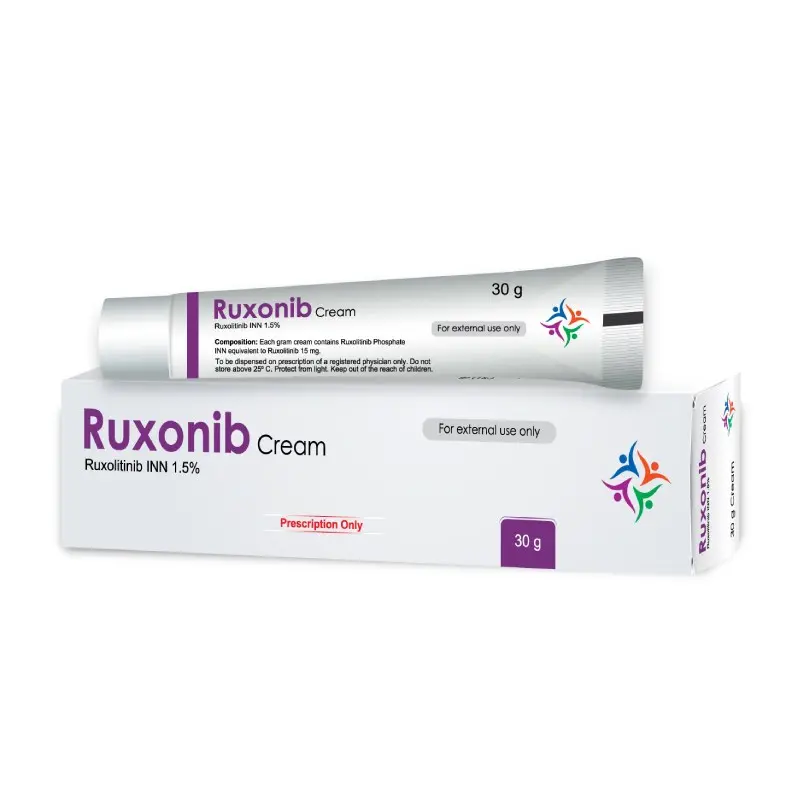
Ruxonib (Ruxolitinib) Cream 1.5% 30g — Topical JAK Inhibitor for Vitiligo & Eczema
Inquire NowGeneric Name: Ruxolitinib (INN)
Brand/Trade Name: Ruxonib
Strength: 1.5% (15 mg ruxolitinib per gram)
Pack Size: 30 gram tube
Manufacturer: Ziska Pharmaceuticals Limited, Bangladesh
Drug Class: Topical Janus Kinase (JAK1/JAK2) Inhibitor
Form: Cream, for topical (skin) use only
Prescription Required: Yes — Dermatologist supervision recommended
⚠️ Boxed Warning Notice: Ruxolitinib belongs to a class of medicines called JAK inhibitors. Oral JAK inhibitors carry a boxed warning for serious infections, increased mortality, malignancy, major cardiovascular events, and thrombosis. While Ruxonib is a topical cream with minimal systemic absorption, this is a prescription medicine that should only be used under the guidance of a qualified dermatologist. Do not use on broken skin, infections, or without medical supervision.
What Is Ruxonib (Ruxolitinib) Cream?
For people living with vitiligo or atopic dermatitis, the search for an effective topical treatment can feel endless — steroid creams that lose effectiveness over time, moisturizers that manage symptoms but never address the underlying problem, and a persistent sense that the immune system itself is working against the skin.
Ruxonib offers a fundamentally different approach.
The active ingredient, Ruxolitinib, is a topical Janus kinase (JAK1/JAK2) inhibitor — the first of its kind to be approved for direct application on the skin rather than taken as an oral tablet. As reported by AJMC, ruxolitinib cream became the first and only FDA-approved treatment specifically for repigmentation in patients with vitiligo — a milestone for a condition that previously had no approved therapy capable of reversing the loss of skin color itself.
Manufactured by Ziska Pharmaceuticals Limited, one of Bangladesh’s well-established pharmaceutical companies, Ruxonib brings this same active molecule to patients across South Asia in an accessible 30-gram cream formulation.
If you are exploring treatment options for chronic skin conditions, you may also find our Dermatology product range helpful for related topical and systemic therapies available on our platform.
What Is Ruxonib Cream Used For?
Ruxolitinib cream has two distinct, FDA-studied indications. Each represents a different way the immune system attacks the skin — and ruxolitinib interrupts both processes at the same molecular level.
1. Nonsegmental Vitiligo (Repigmentation Therapy)
Vitiligo occurs when the immune system mistakenly attacks melanocytes — the pigment-producing cells in the skin — leading to patches of depigmented (white) skin. According to AJMC’s clinical reporting, this approval was based on the pivotal Phase 3 TRuE-V clinical trial program, which evaluated ruxolitinib cream against a non-medicated vehicle cream in more than 600 patients with nonsegmental vitiligo affecting up to 10% of total body surface area.
Ruxonib is indicated for adult and pediatric patients 12 years of age and older with nonsegmental vitiligo — the most common form, where patches appear symmetrically across both sides of the body.
2. Mild to Moderate Atopic Dermatitis (Eczema)
Atopic dermatitis is a chronic inflammatory skin condition driven by overactive immune signaling, leading to dry, itchy, inflamed skin. Per drug approval records, ruxolitinib cream was approved for the short-term and non-continuous chronic treatment of mild to moderate atopic dermatitis in non-immunocompromised patients whose disease is not adequately controlled with topical prescription therapies, or when those therapies are not advisable.
Originally approved for patients 12 years and older, this indication was later expanded. As AJMC reported, the approval was extended to children as young as 2 years old based on data from the Phase 3 TRuE-AD3 trial, which showed significantly more children achieved treatment success with ruxolitinib compared to a non-medicated control cream.
Important distinction: Ruxonib is approved for short-term and non-continuous chronic use in atopic dermatitis — meaning it is not intended for indefinite, uninterrupted daily application. Your dermatologist will guide you on appropriate treatment cycles.
How Does Ruxonib (Ruxolitinib) Cream Work? (Mechanism of Action)
To understand why this cream works differently from a typical steroid, it helps to understand the JAK-STAT pathway — the immune system’s internal messaging system.
Inside skin cells, a family of enzymes called Janus kinases (JAK1 and JAK2) relay signals from cytokines — small proteins that drive inflammation. According to the FDA’s official prescribing information, ruxolitinib inhibits JAK1 and JAK2, which mediate the signaling of cytokines and growth factors important for hematopoiesis and immune function.
In vitiligo, this signaling pathway drives the immune attack on melanocytes. By blocking JAK1/JAK2 signaling locally at the site of application, ruxolitinib interrupts the inflammatory signal that destroys pigment-producing cells — creating an environment where melanocytes can survive and, over time, regenerate pigment.
In atopic dermatitis, the same JAK-STAT pathway drives the cytokine signaling (particularly interleukins like IL-4 and IL-13) responsible for the itching, redness, and inflammation characteristic of eczema. Blocking this pathway locally reduces inflammation at the source, rather than broadly suppressing the immune system the way oral corticosteroids do.
Because Ruxonib is applied topically rather than taken orally, systemic absorption is significantly lower than with oral JAK inhibitors — which is the basis for its different safety profile, though the boxed warning class effects still apply as a precaution.
How to Use Ruxonib Cream — Application Instructions
For Vitiligo:
- Apply a thin layer to affected areas twice daily, at least 8 hours apart
- Treatment area should not exceed approximately 10% of total body surface area
- Visible repigmentation typically takes time — clinical trials measured results at 24 and 52 weeks, reflecting the gradual nature of repigmentation
- Continue use only as directed by your dermatologist; longer-term studies showed improved results with continued treatment over 52 weeks compared to 24 weeks
For Atopic Dermatitis:
- Apply a thin layer to affected areas twice daily
- Use for short-term and non-continuous chronic treatment — not intended for uninterrupted, indefinite daily use
- Treatment area should not exceed approximately 20% of body surface area
- Maximum recommended use: continuous treatment beyond 8 weeks should be reassessed by your dermatologist
General application guidance:
- Wash hands before and after application (unless hands are the treatment area)
- Apply only to affected skin — do not apply to healthy, unaffected skin unnecessarily
- Do not apply to broken skin, open wounds, or active infections
- Avoid contact with eyes, mouth, and vagina
- Do not use with occlusive dressings (bandages that trap the cream) unless instructed by your dermatologist
- Do not bathe, shower, or swim immediately after application — allow the cream to absorb
Ruxonib is for external use only. Do not swallow.
What Are the Benefits of Ruxonib Cream for Patients?
The first treatment that targets repigmentation directly: Rather than just camouflaging or managing vitiligo symptoms, Ruxonib works at the immune signaling level believed to drive melanocyte destruction — addressing a root mechanism of the disease rather than its appearance alone.
A steroid-free option: For patients who have used topical corticosteroids long-term and are concerned about skin thinning, stretch marks, or steroid dependency, Ruxonib offers a non-steroidal mechanism that does not carry the same risk of skin atrophy with prolonged use.
Strong clinical trial backing: Both indications are supported by large, randomized, vehicle-controlled Phase 3 trial programs — TRuE-V for vitiligo and TRuE-AD for atopic dermatitis — giving dermatologists substantial real clinical data to guide treatment decisions.
Localized treatment, lower systemic exposure: Because Ruxonib is applied directly to affected skin rather than taken as a pill, the medicine works largely where it is needed, with comparatively limited systemic drug exposure relative to oral JAK inhibitors.
Pediatric option available: With FDA data supporting use in children as young as 2 years old for atopic dermatitis (subject to physician evaluation), Ruxonib offers families an additional option when standard topical treatments are insufficient.
Affordable access through generic manufacturing: Manufactured by Ziska Pharmaceuticals Limited, Ruxonib makes this advanced topical JAK inhibitor accessible to patients in Bangladesh and the surrounding region, where the branded version (Opzelura) may be prohibitively expensive or difficult to source.
Side Effects — What Patients Should Know
Topical Ruxolitinib is generally well tolerated, but as with any prescription medicine, side effects can occur — ranging from mild and local to rare but serious systemic effects.
Commonly Reported Side Effects:
For Atopic Dermatitis patients, clinical trial data reported by Incyte identified the most common side effects as nasopharyngitis (common cold), diarrhea, bronchitis, ear infection, increased eosinophil count, hives, folliculitis (inflamed hair follicles), tonsillitis, and rhinorrhea (runny nose).
For Vitiligo patients, the most commonly reported side effect was acne at the application site, along with itching, redness, and other mild local skin reactions.
Most of these effects are mild and tend to resolve without stopping treatment. Local application-site reactions such as redness, stinging, or itching at the site are the most frequently reported issues overall.
Serious Risks — Class Warning for JAK Inhibitors:
Even though Ruxonib is applied to the skin rather than taken orally, it belongs to the same drug class (JAK inhibitors) that carries a boxed warning when used orally for other conditions. As stated in the FDA’s prescribing information, this boxed warning covers serious infections, increased mortality, malignancy, major cardiovascular events, and thrombosis observed with JAK inhibitors used for inflammatory conditions.
⚠️ Serious Infections
JAK inhibitors can reduce the immune system’s ability to fight infections, including tuberculosis and other bacterial, fungal, or viral infections. Some lower respiratory tract infections have been reported in clinical trials of topical ruxolitinib specifically. Do not start Ruxonib if you have an active infection unless your doctor advises otherwise.
⚠️ Blood Clots (Thrombosis)
Blood clots in the legs (deep vein thrombosis) or lungs (pulmonary embolism) have been associated with this drug class, more frequently in patients over 50 with cardiovascular risk factors taking oral JAK inhibitors.
⚠️ Low Blood Cell Counts
Reduced platelet counts (thrombocytopenia), reduced red blood cells (anemia), and reduced white blood cells (neutropenia, lymphopenia, leukopenia) have been reported. Periodic blood tests may be recommended depending on the extent and duration of use.
⚠️ Cholesterol Increases
Elevated cholesterol levels have been observed with oral ruxolitinib use.
If you experience symptoms of infection (fever, persistent cough, fatigue), signs of a blood clot (leg swelling, chest pain, shortness of breath), or any unusual bruising or bleeding while using Ruxonib, contact your dermatologist immediately.
Important Warnings and Precautions
Tell your dermatologist before starting Ruxonib if you:
- Have any active infection, including localized skin infections
- Have a history of tuberculosis or have been exposed to TB
- Have a history of blood clots, heart disease, or stroke
- Have chronic hepatitis B or C infection
- Have a history of cancer or are currently immunocompromised
- Are pregnant, planning pregnancy, or breastfeeding
Use in Immunocompromised Patients:
Ruxonib is specifically indicated for non-immunocompromised patients. If you are taking other immunosuppressant medications, biologics, or oral JAK inhibitors, discuss this carefully with your dermatologist, as combination use is generally not recommended.
Pregnancy and Breastfeeding:
The effects of topical ruxolitinib during pregnancy have not been fully established in humans. FDA labeling notes that animal studies did not show treatment-related malformations, but human data remains limited. Discuss the risks and benefits with your dermatologist if you are pregnant or planning pregnancy.
Use in Children:
For atopic dermatitis, use in children under 2 years of age has not been established. For vitiligo, safety and effectiveness have been established only for patients 12 years and older.
Drug Interactions
Although systemic absorption from topical use is limited compared to oral JAK inhibitors, Ruxolitinib is metabolized by the CYP3A4 liver enzyme, and interactions are still possible — particularly with extensive or prolonged use over large skin areas.
Medications that may increase Ruxolitinib absorption (CYP3A4 inhibitors):
- Ketoconazole and other strong antifungals
- Certain antibiotics (e.g., clarithromycin)
- Some antiretroviral medications
Avoid combining with:
- Other JAK inhibitors (oral or topical)
- Biologic immunosuppressants (e.g., for psoriasis, eczema, or autoimmune disease)
- Potent immunosuppressants such as azathioprine or cyclosporine
Always share your complete medication list — including other topical and systemic treatments — with your dermatologist before starting Ruxonib.
How to Store Ruxonib Cream
- Store at room temperature, between 15°C and 30°C
- Do not freeze
- Keep the tube tightly closed when not in use
- Store out of reach of children and pets
- Do not use past the expiry date printed on the packaging
- Discard any unused cream as directed by your pharmacist after the treatment course ends
About Ziska Pharmaceuticals Limited
Ziska Pharmaceuticals Limited is one of Bangladesh’s recognized pharmaceutical manufacturers, with a broad portfolio spanning dermatology, general medicine, and specialty formulations. Their commitment to quality manufacturing standards has positioned them as a trusted name for patients seeking effective, accessible alternatives to expensive imported branded medicines.
Ruxonib represents Ziska’s entry into advanced topical immunomodulator therapy — bringing a clinically significant treatment for vitiligo and atopic dermatitis within reach for patients across Bangladesh and the surrounding region.
Related Products Available at 100Meds
Patients managing vitiligo, eczema, or other chronic inflammatory skin conditions may also find these related products on our platform useful:
- Browse our complete Dermatology range →
- Oncology product range — For patients managing concurrent conditions requiring specialist oncology medicines
- Contact our team — for guidance on sourcing this and other dermatology medicines safely
All treatment decisions should be made in consultation with a qualified dermatologist based on your specific skin condition, medical history, and treatment goals.
Frequently Asked Questions About Ruxonib (Ruxolitinib) Cream
Q: What is the generic name of Ruxonib?
The generic (INN) name is Ruxolitinib. Ruxonib is the brand name manufactured by Ziska Pharmaceuticals Limited in Bangladesh. The original branded version, developed by Incyte Corporation, is sold internationally as Opzelura.
Q: Is Ruxonib cream the same as Opzelura?
Yes, in terms of active ingredient. Both contain Ruxolitinib 1.5% in a topical cream formulation. Opzelura is the originator brand manufactured by Incyte; Ruxonib is a generic formulation manufactured by Ziska Pharmaceuticals for accessibility in South Asian markets.
Q: How long does it take to see results with ruxolitinib cream for vitiligo?
Repigmentation is a gradual process. Clinical trial data showed that a significantly greater proportion of patients achieved meaningful facial repigmentation at 52 weeks compared to 24 weeks, indicating that longer, consistent treatment tends to produce better visible results. Patience and consistent application, under dermatologist guidance, are essential.
Q: Can I use Ruxonib cream every day indefinitely?
For vitiligo, ongoing use under dermatologist supervision is typical, with periodic reassessment. For atopic dermatitis, the FDA approval specifically describes “short-term and non-continuous chronic treatment” — meaning it is not intended for uninterrupted, indefinite daily use. Your dermatologist will determine appropriate treatment cycles for your condition.
Q: Is Ruxonib safe for children?
For atopic dermatitis, it is approved for non-immunocompromised children as young as 2 years old. For vitiligo, it is approved for patients 12 years and older. A pediatric dermatologist should make the final determination for any child’s treatment plan.
Q: What is the price of Ruxonib (Ruxolitinib) 1.5% cream 30g?
Pricing varies depending on quantity and regional availability. Please use the Inquire Now button or contact us via WhatsApp/Telegram for current pricing.
Q: Is it safe to order Ruxonib online from 100Meds?
100Meds operates as a verified pharmaceutical sourcing platform with transparent, documented supply chains. We do not dispense prescription medicines without proper documentation. Contact our team for guidance through the ordering process.
A Note to Patients Living With Vitiligo or Atopic Dermatitis
Chronic skin conditions carry a weight that extends far beyond the visible symptoms. Vitiligo can affect confidence and identity in ways that go unspoken. Atopic dermatitis can disrupt sleep, concentration, and daily comfort for years on end. For many patients, the frustration is not just the condition itself, but the years spent cycling through treatments that manage symptoms without addressing what’s actually happening beneath the skin.
Ruxonib does not promise a cure. What it offers is a clinically studied, FDA-validated mechanism — now manufactured and made accessible in Bangladesh — that works at the immune signaling level believed to drive both conditions. For some patients, that represents the first real progress they’ve experienced in years.
At 100Meds, our role is to help you access the medicine your dermatologist has prescribed — affordably, transparently, and with proper guidance every step of the way.
Reach out to our team today for pricing, availability, and ordering assistance.
This page is for informational purposes only and does not constitute medical advice. Ruxonib (Ruxolitinib) Cream 1.5% is a prescription medication. Always consult a qualified dermatologist before starting, stopping, or adjusting treatment for vitiligo, atopic dermatitis, or any skin condition.
Additional information
| Brand | Ziska Pharmaceuticals Limited |
|---|---|
| Origin | Bangladesh |
| MFG. LIC. NO | 183 & 424 |
| MA. NO. | 242-506-010 |
You must be logged in to post a review.

Reviews
There are no reviews yet.